The COMET Model
Foundational principles
Collective stewardship
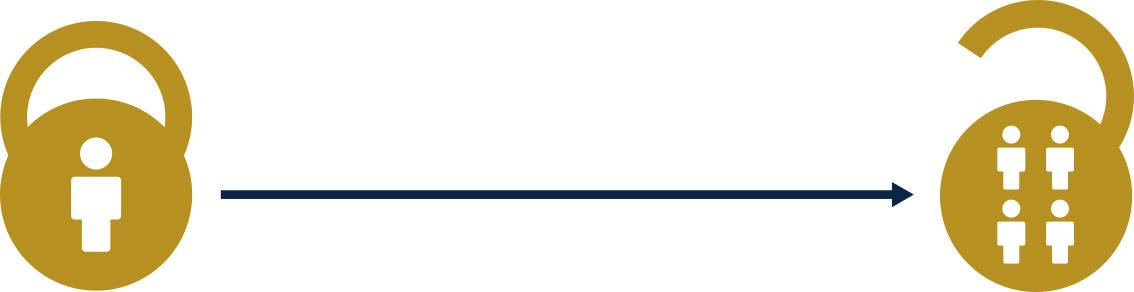
The COMET Model shifts the responsibility of metadata quality from individual depositors to a distributed community partnership. Crucially, this does not undermine source authority—it complements it. The model recognises that source authority and metadata quality are distinct. Research outputs are the product of many actors whose collective expertise should be empowered to produce a complete and accurate scholarly record.
Collective benefit
The COMET Model addresses the fragmented benefits that result when organisations tackle metadata problems in isolation. Independent fixes by universities, funders, and service providers solve local problems but result in duplicated improvements that never reach the authoritative source. The model provides a collective framework for these community-contributed improvements, structured as open, machine-actionable assertions, to flow back to authoritative sources.
Trust through transparency
Traditional PID workflows root trust in the identity of the registrant; the COMET Model extends this by establishing trust in open processes that are rigorous and evidence-based. COMET’s enrichments are supported by traceable provenance documentation and publicly shared evaluative frameworks, providing a robust foundation for trustworthy community contributions to the open scholarly record.
The COMET Model
Key elements
Unite quality metadata curation assets
The COMET Model confronts one of the most persistent inefficiencies in scholarly communications: valuable, high-quality curation in isolated systems never reaches the wider community. From institutionally verified datasets to proven, scalable enrichment methods—the COMET community brings these assets together, unlocking their collective value.
Where gaps remain, the COMET organisers act as facilitators, developing innovative capabilities with community partners. The goal is to connect solutions across institutional and geographical boundaries to maximise the value of community investments.
Target diverse research outputs and stakeholders
Inclusive design produces solutions that reflect genuine community needs. The COMET Model addresses metadata quality gaps across research outputs, from datasets and software to posters and articles, ensuring solutions benefit a wide range of stakeholders, such as research institutions, libraries, publishers, and funders.
Enable multiple round-tripping pathways
The COMET community sees successful round-tripping as enrichments flowing back into the systems that maintain and disseminate scholarly metadata. Achieving this requires multiple, complementary pathways. For example, PID-first pathways, such as direct integration with DOI registration agencies, are crucial because they prevent improvements from fragmenting across the ecosystem, while platform-supported pathways, such as connections with submission and publishing systems, offer opportunities to improve metadata as part of communities’ existing workflows.
Treat metadata fields as product features
Inspired by software development that makes systematic progress possible, the COMET Model treats each metadata field as a discrete, improvable feature, enabling focused problem-solving and measurable progress. Each project the COMET community undertakes focuses on a single metadata field, producing improvements that can be implemented at scale.
COMET prioritises the following use cases:
| Use case | Metadata fields |
|---|---|
| Name and describe research outputs | Title; Work/Resource Type; Language |
| Identify and connect people associated with research outputs | Author/Creator; Contributor |
| Identify and connect organisations associated with research outputs | Affiliation; Funder/Funding |
| Identify and connect related research outputs | References; Related Identifiers |
| Identify access policies associated with research outputs | License/Rights |